
Notes from the Field: Seeing Community, Mapping & Learning Together
Alt Title: A reflection on maps, relationships, community and the practice of learning to see
This post sits with the second article in the “Rooted In Community” series by Geraldine Cahill and Louise Adongo. It carries the energy of community practice: noticing what is already present, paying attention to relationships, and asking how communities find resourceful ways to be, co-be, and inter-be.
The article begins with a simple enough question about mapping interconnections in the community capital field. But, as often happens when we are actually paying attention, the question changed. After the Catalyst Community Finance Summit in Winnipeg, and through feedback and ongoing conversations, the deeper question became: beyond the interconnections we map, how do we learn to see community?
That shift matters. A map is an output. Seeing is a practice. Learning is a capability. Community is not only its organizations, funding, services, assets, or beneficiaries. Community is also the living, multidirectional relationships that make things possible: trust, governance, land, culture, ecology, institutions, memory, and the quiet ways people hold each other through change.
In this piece, maps are not treated as neutral tools. Every map tells a story. Every map also leaves something out. The same community can be seen differently by a practitioner, an investor, or an institutional partner. One may see belonging and relationships. One may see long-term conditions and regenerative capacity. One may see coordination across overlapping systems. None of them holds the whole picture alone. Together, they help us ask better questions about what is visible, what is obscured, and what futures become imaginable.
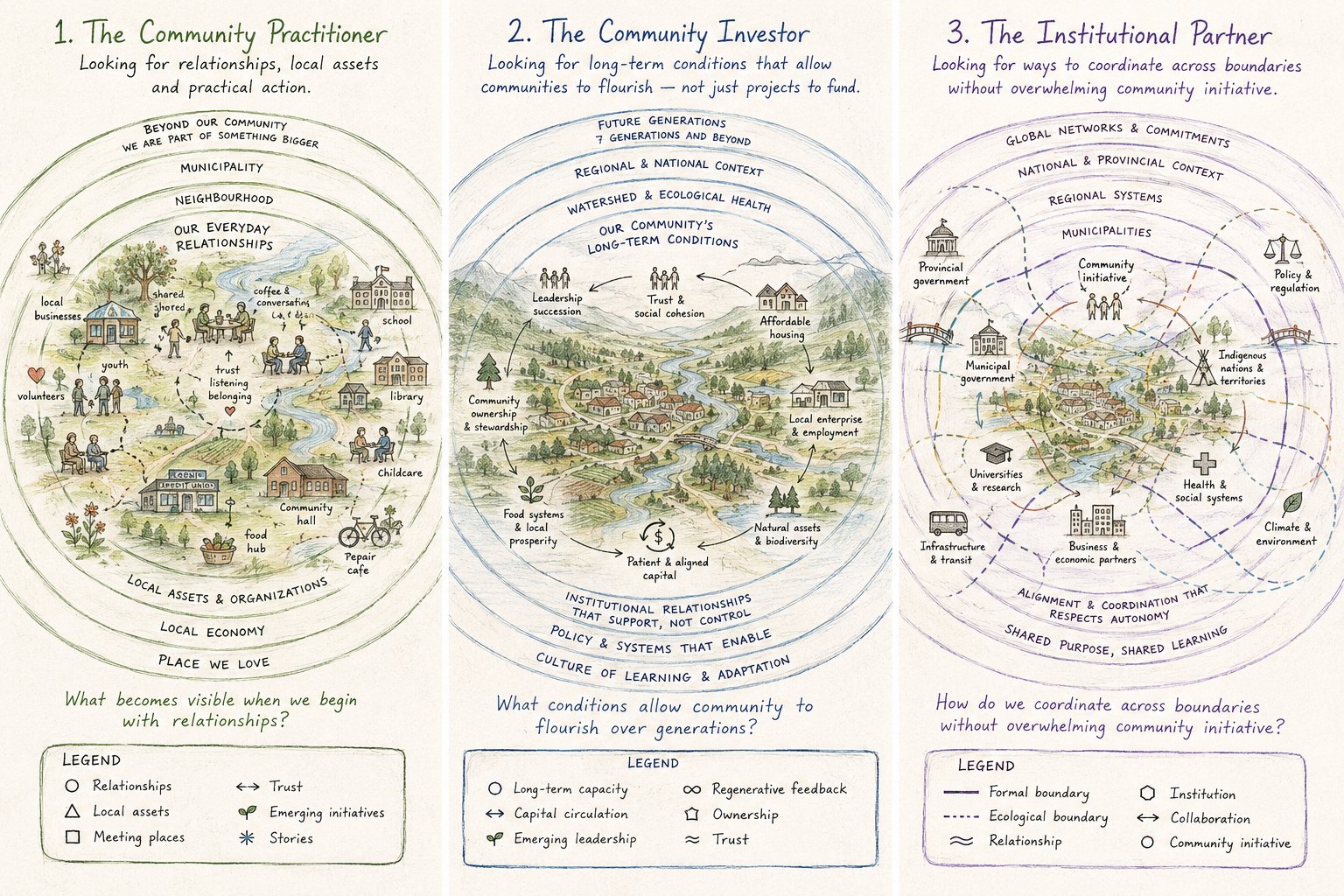
A Map Triptych - three maps of the same community by three personas - AI generated by the author of this post.
The article also holds community finance in its right-sized place. Finance matters, but it does not have to be ‘the horse pulling the cart’ (to quote Jo Reynolds). We start with purpose and relationship, with where we are and what is motivating our collective desire to change things. Then we choose the map that fits the question. Then, perhaps, we test small experiments. And where finance becomes useful, we engage it with more clarity about its purpose and application.
This is also where the piece invites a shift from orchestration to flow. Not everything should be held and directed. Some of the work is illumination: helping communities see themselves, helping patterns become visible, helping wisdom move across places, fields, and sectors, and noticing how communities already orchestrate themselves when the conditions are right.
The reference to the social finance case study in Part 2 of the Fields & Wisdom essay is held lightly here. It is not the frame for the article. It is one example among others of how a case study, like a persona or a map, can help people see a field from more than one standpoint.
The article closes with an invitation to join Catalyst Community Finance in Mighty Networks.
The invitation is practical, and it is also human: bring a map, bring a voice note, bring a question, bring something unfinished. The Catalyst Community Finance Mighty Network Sandbox is offered as a place to keep learning together, because communities are never finished. Neither are their maps. There is always something else to notice, something else to ask, something else to try.
A note on AI use: AI tools may be used to assist with organization, formatting, or visual execution of work authored and analytically determined by the author. AI is not used to define problems, make normative judgments, or determine policy implications. All substantive framing, interpretation, and accountability remain human-led.
Caprivian Strip - Work with us!
Caprivian Strip Inc helps people in organizations see the systems they are already living within, and supports them to shape their work in those systems in ways that feel authentic, human, and connected through the conversations that move us forward together.