
Fields & Sectors: Wisdom & Practice (Part 2)
Alt Title: Stabilization, Games, Strain and the possibility of Redistribution
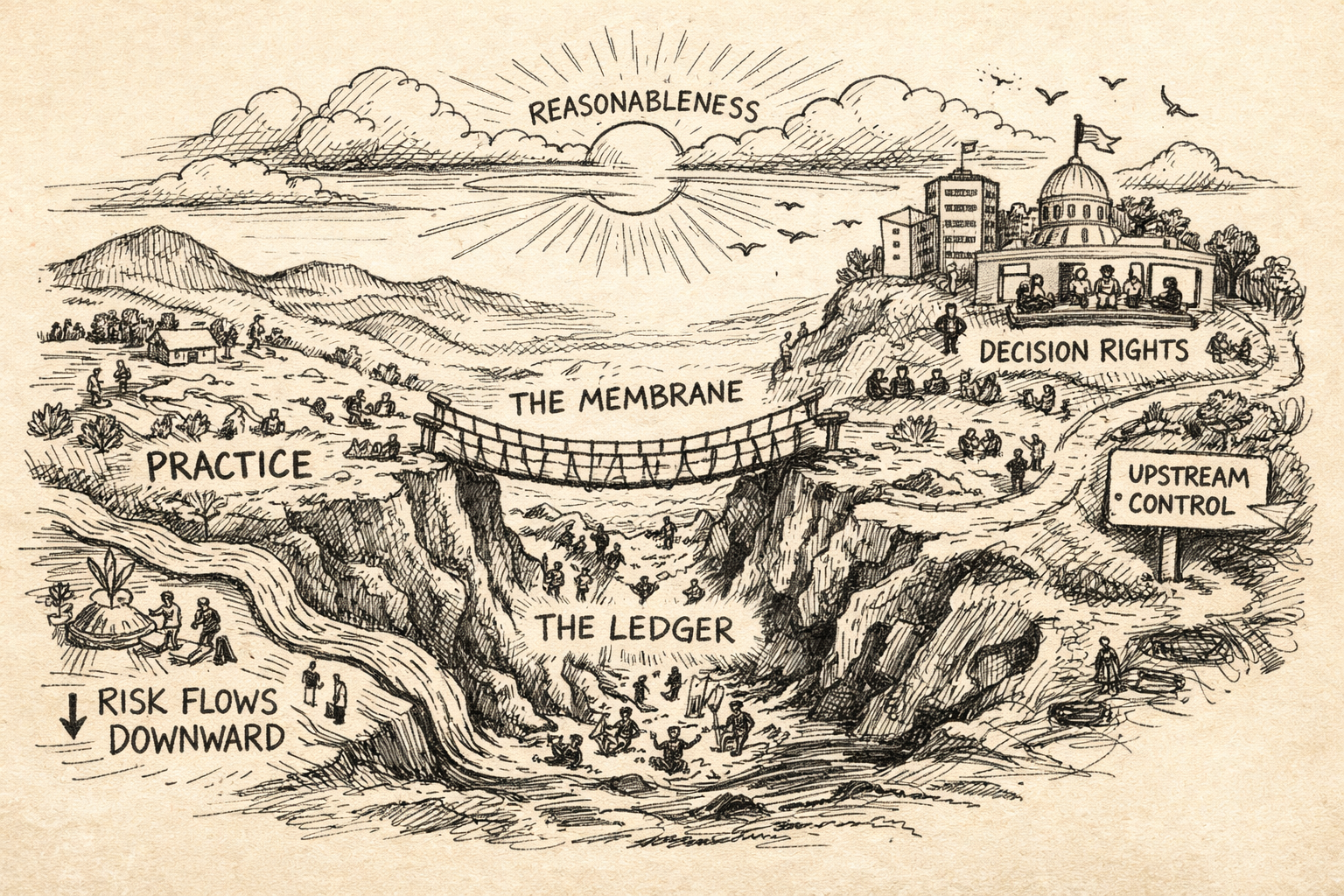
Fig 1: Membrane in the Land of Reasonableness. AI generated image.
The terrain separates the site of practice (where consequence lands) from the site of authority (where standards and decisions are set). The membrane is the selectively permeable interface that regulates what crosses. Bridging appears as visible connective tissue, but the membrane remains stable through distributed stabilization patterns—reporting norms, credentialing, metric regimes, convening scripts, and the moral language of stewardship.
TL;DR The essay provides a simple way to understand how fields remain stable under tension. In Part 1 of the essay I describe actors in the field by their actions through a power lens. And introduce field stabilization dynamics that support reasonableness. In Part 2, I propose explanations for how fields maintain legitimacy while managing contradiction. Fields are structured through membranes that separate practice from authority. These membranes remain stable through a set of recurring stabilization games—visibility, legitimacy, translation, containment, and risk allocation. Strain accumulates differently depending on field temperature and visibility regimes. When strain exceeds the system’s capacity to absorb it, and the structure beneath familiar tensions in fields become more visible, perhaps the redistribution of authority (and consequence) becomes possible.
Recap and Overview
Part 1 of the essay re-calibrates field sensing, field building, and field bridging with power analyses. Field sensing makes the field legible, Field building hardens legibility into infrastructure, standards, and fundable abstractions. Field bridging navigates tensions, translating between practice and authority which is metabolically expensive work that rarely holds final decision rights (see Fig 1). It also introduces the membrane, as the selective interface between practice and authority, and games as the avenues by which the membrane (and thus field) is stabilized.
In Part 2, I bring the games to the foreground as recognizable patterns operating in real fields rather than background processes. Four case studies will demonstrate that these are not abstract concepts. The same stabilization patterns appear across very different sectors but are filtered variably in each case study. My observations in this essay arise from inhabiting several roles within them. Roles as practitioner, bridger, field participant, and observer (senser or builder).
How Fields Keep Themselves Reasonable: Membrane Stabilization Strategies and Patterns
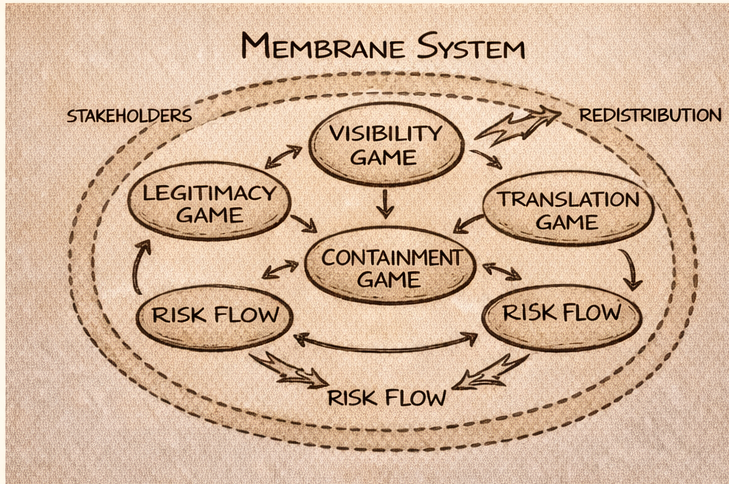
Fig 2: A membrane ecology of games in fields. Membranes regulate what crosses from lived consequence into decisions and standards. AI generated image
In keeping themselves reasonable, fields are rarely governed by a single membrane.
Membranes are often layered, and nested membranes occur at each level in fields: community → practitioner → organization → field → policy → global governance. And, filters apply differently at each level as well (i.e. they might be more or less porous).
Membranes regulate movement of knowledge as well as the transformation of knowledge in its abstraction (by translation) by bridgers. The stabilization games describe exactly how ‘membrane crossings’ are managed.
“fields distribute consequence, authority, and legitimacy unevenly. Practice bears consequence, institutions hold authority, and legitimacy determines which knowledge travels between them.” - excerpt from Part 1 of this essay
Knowledge(s), Critique & Membranes
In Part 1 of the essay we consider how critique circulates and we also ask the questions: Who builds? Who senses? Who bridges? Who practices? What knowledge travels [upwards] as evidence? What disappears? (and) Who decides?
When different translation filters are applied across membranes at different field levels, some context or nuance is lost when things are simplified, reframed, neutralized or (de)legitimized. This creates a tension which goes beyond ‘critique that circulates while authority remains centralized’. The patterns inherent in the consequences of translation and abstraction carry emotional and ethical weight.
Critique moves [circulates or travels] across membranes that filter ‘decisional’ force. People (especially bridgers, but also practitioners and community members) absorb moral residue without redistributive authority, often quietly, often alone.
*I will say more about the paradox (and implications) of how critique circulates/ travels for the possibilities of redistribution later on in the essay.
The GAMES
Games in the fields of the land of reasonableness are survival strategies inside systems that reward continuity. They are also how people come to carry systemic complicity privately—on an unwritten ledger.
Though the same five games exist across the field (and are illustrated in the case studies), they manifest differently depending on the level of the membrane and different stabilization strategies (interdependency of the games) occurs.
As repeatable coordination strategies, these games feel reasonable, are rewarded by institutions, and quietly stabilize existing distributions of authority.
Tl;DR: Part 1 shows that field bridging is the contested terrain between practice, sensing and building. Fields begin with practice but authority (& legitimacy?) begins at field building. The bridgers feel the most field friction; though the consequences of field dynamics are most felt in the grassroots by communities. Practice generates consequence and experiential knowledge while institutional authority determines standards, legitimacy, and decision rights. The membrane translates some forms of practice knowledge into institutional forms such as metrics, reports, and professional standards.
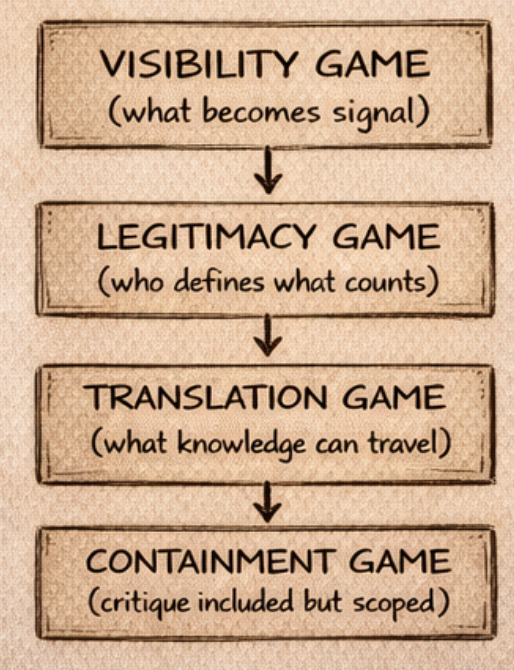
Fig 3: Fields must coordinate work. To coordinate it, they create legitimacy structures. But legitimacy structures sometimes filter or soften (or co-opt) truth. Co-optation is merged with legitimacy in this AI generated image.
The stabilization games manage that tension between abstraction for broader utility or translation that becomes erasure of nuance and meaningful context.
NOTE: In this essay I do not use “game theory” formally but rather references “games” in the sociological sense: as patterned strategic interaction inside structured arenas of power. The works of authors in these traditions converge on a practical point: systems persist through patterned interaction, often experienced as reasonable process.
Table 1 below identifies recurring stabilization patterns operating across fields.

These games are stabilization strategies that maintain institutional coherence by translating lived experience into acceptable forms, absorbing critique without altering governance structures, and redistributing responsibility downward while preserving the legitimacy of decision-making institutions.
Field Friction, Strain and Temperature
Field temperature, which introduces the conditions under which the games begin to strain, shows that stabilization is dynamic. Fields remain stable not because tensions disappear, but because membranes and stabilization games continually manage how consequence, knowledge, and authority are allowed to move.
Strain often begins at lower membranes. Practitioners notice contradictions first and then the field reacts by absorbing the strain, translating it or dealing with escalation.
If the strain is absorbed, adaptations prevent the strain from moving upward.
If the strain is translated, then it becomes reframed into manageable evidence.
And, if things escalate, the strain crosses multiple membranes and becomes visible at the field or policy level.
This figure includes a further subset of games (Learning, Piloting, Representation , Complexity and Applause) at play. Though they are described in the column about how systems are prevented from shifting in Table 1 above), they are not the main games we focus on in this essay. I am not outside these games. I have participated in them—as a practitioner, a translator, a bridger.
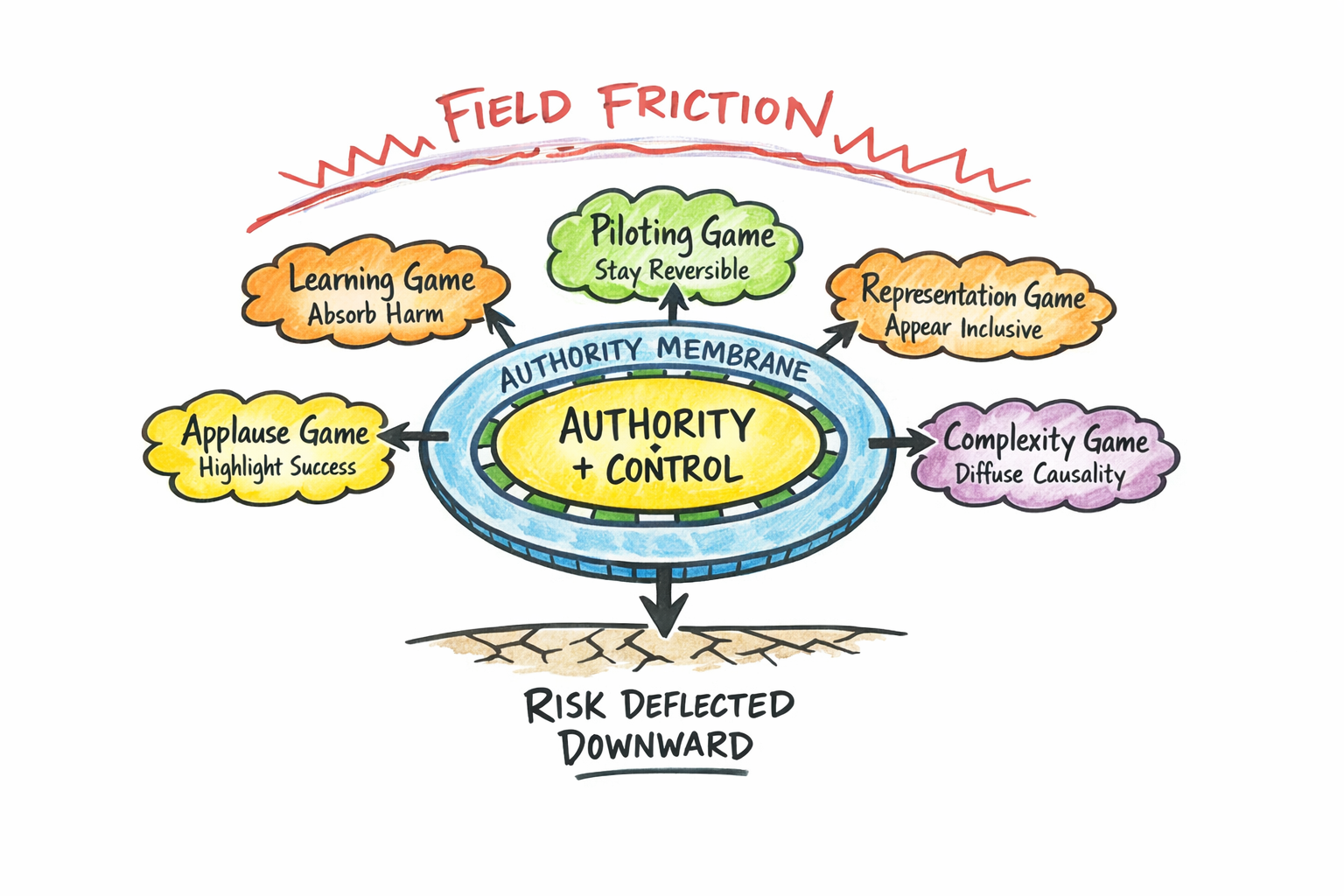
Fig 4: The field remains coherent not by eliminating tension but by routing it through patterned interaction. Learning cycles, pilots, representation work, complexity language, and applause rituals can metabolize critique into legitimacy-preserving forms. This is not open conflict; it is reasonableness doing stabilization work. AI generated image.
This figure includes a further subset of games (Learning, Piloting, Representation , Complexity and Applause) at play, described in column 4 of Table 1 above). I am etangled in the ecology of fields and as such I am not outside these games.
Same Games, Different Temperatures
Fields organized around brittle legitimacy mechanisms tend to break publicly. Others persist by continuously absorbing critique. Stabilization continues until the cost of maintaining coherence exceeds the cost of acknowledging contradiction.
As critique moves in fields, something almost always changes. Urgency stretches into pilot cycles, lived contradiction softens into “tension,” procedural knowledge becomes legible insight, and responsibility remains unevenly distributed. These transformations help explain why destabilization is rarely simple. When the stabilization games begin to fail, what emerges is not only the possibility of redistribution but also a series of risks fields often try to avoid: coordination can slow, evidence regimes may lose their shared legitimacy, professional relationships can fracture, and the actors closest to practice may inherit new authority without the resources needed to exercise it. For this reason systems often attempt several forms of stabilization before structural change occurs.
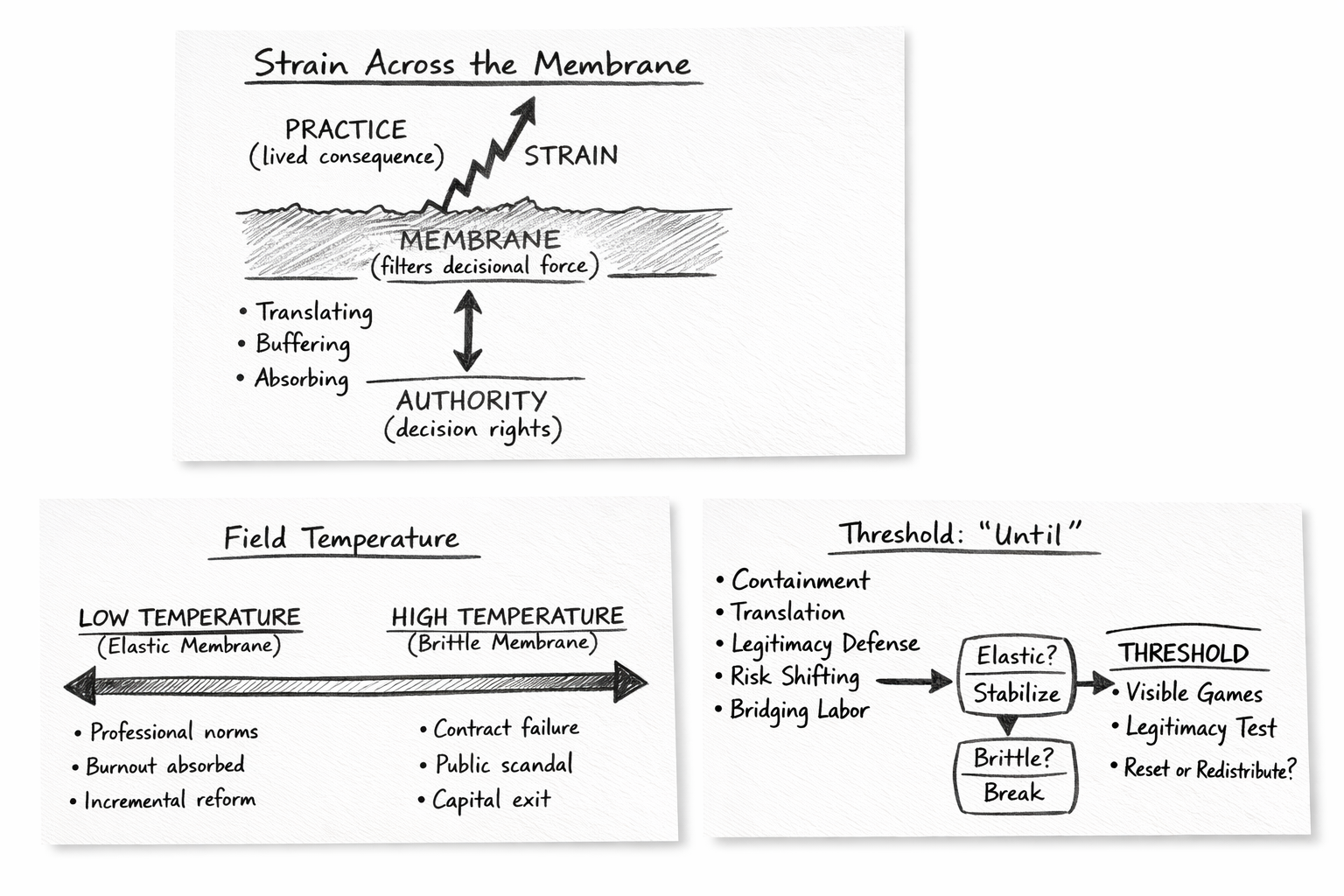
Fig 5: A Membrane Typology Across Field Temperatures. The central claim of this essay (Part 2) is that stabilization patterns maintain the membrane between practice and authority ‘ until’ strain produces an inflection point. AI generated image.
What this shows: the same stabilization games operate across fields, but field temperature determines whether strain is quietly absorbed, translated into legitimacy‑preserving forms, or forced upward into visibility.
The Case Study Examples
To illustrate how stabilization games operate across fields, this essay turns to four cases.
Two show stark strain, where contradictions surface publicly. Two show subtle strain, where tensions remain largely absorbed within professional discourse.
Prolonged stabilization under strain: Subtle cases occur when translation and containment succeed in stabilizing the tension. Stark cases (like the microfinance crisis) occur when escalation cannot be contained.

Fig 6: A Membrane Typology Across Four Cases
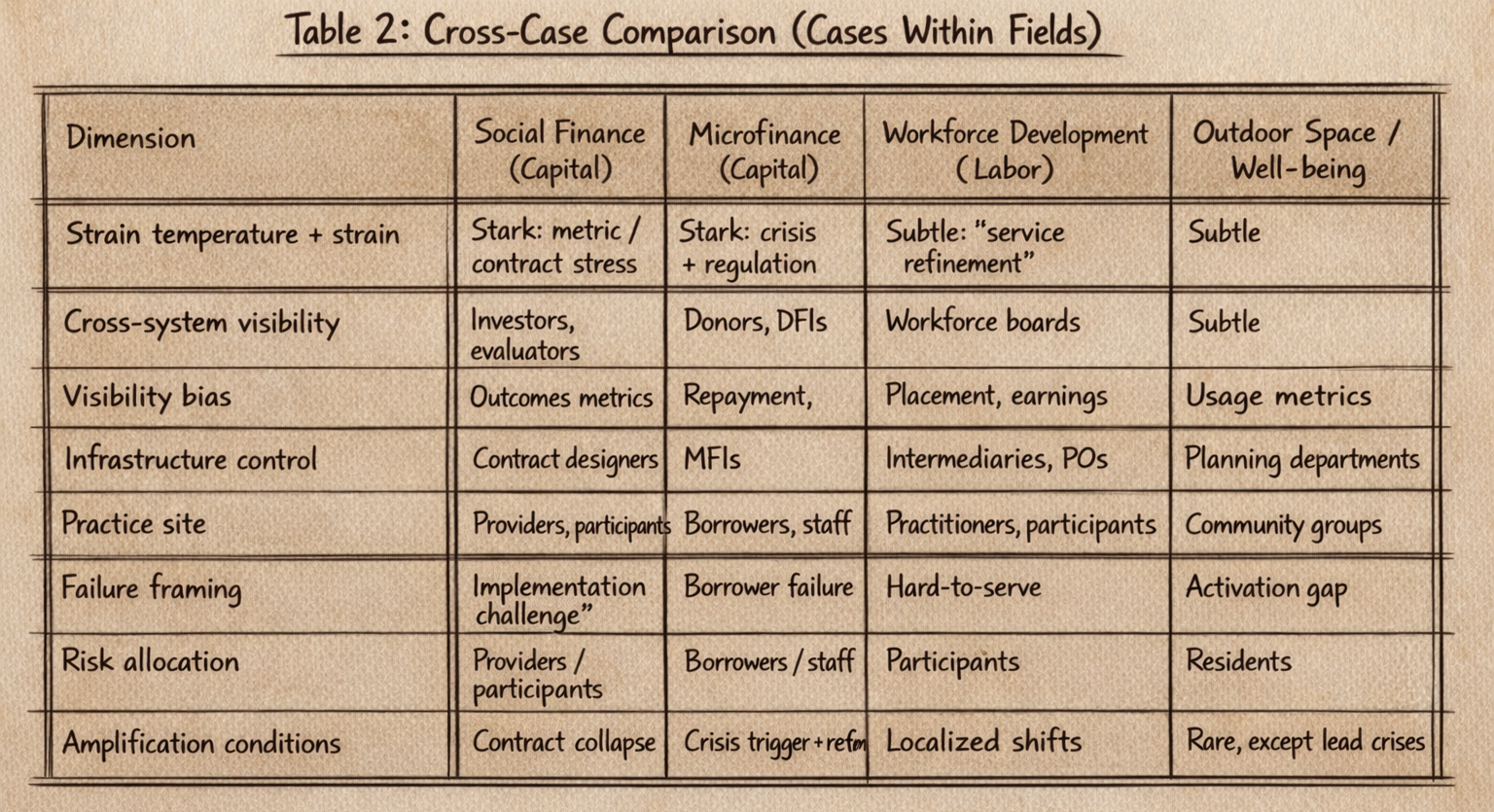
Across all four, the pattern that becomes most visible is risk allocation: how [and to whom] responsibility and consequence travel through the field.
Case 1 (Stark): Microfinance (When Repayment Becomes Risk)
Microfinance emerged with a compelling promise: small loans would unlock entrepreneurial capacity among people excluded from traditional financial systems. Repayment rates would demonstrate both financial sustainability and social progress.
For many years, the field stabilized around those metrics. Repayment became the visible signal of success. Investors, development agencies, and practitioners coordinated around that indicator. Yet repayment is not the same as wellbeing. Borrowers often carried multiple debts across formal and informal lenders. Household income fluctuated. Loans were repaid through extraordinary effort, social pressure, or additional borrowing. These realities were visible to practitioners long before they appeared in the discourse of the field.
The Andhra Pradesh crisis of 2010 made those tensions impossible to ignore. Reports of borrower distress and regulatory intervention revealed a contradiction at the center of the model: repayment success did not necessarily mean borrower stability. At that moment the stabilization games became visible.
Translation had converted complex livelihoods into repayment statistics. Legitimacy had accumulated around financial metrics. And risk—when loans failed or distress surfaced—remained concentrated with borrowers themselves. The crisis did not end microfinance. The field adjusted, introducing stronger regulation and consumer protections.
This case illustrates how translation of microfinance from practice to scale may have left out key ingredients for success so that while financial inclusion succeeded (through visibility and legitimacy) on paper, the risk and consequences of misapplied knowledge was downloaded to borrowers when theory met reality.
Case 2 (Subtle): Workforce Development (When Training & Skills Meet Labor Market Needs)
Workforce development systems promise a bridge between training and employment. Programs help workers acquire skills aligned with labor market demand, while policy frameworks attempt to coordinate employers, educators, and job seekers. The model appears orderly (reasonable even, smile). Training leads to placement; placement signals success. The story, from practitioner vantage points is more complicated; a lot goes into readiness for skills development (a lot that has to do with sense of self, community & belonging).
Employment outcomes depend on housing stability, transportation networks, childcare access, health, and the volatility of local economies. Practitioners working directly with job seekers encounter these constraints every day.
The stabilization games here are quieter but familiar. Translation converts lived complexity into program categories. Legitimacy attaches to institutions that define training standards. Containment absorbs critique through pilot programs, program redesign, and new funding cycles. The risk, however, remains unevenly distributed, weighted heavily towards practitioners and program participants. Individuals are held responsible for systemic issues.
When employment outcomes fall short, responsibility often returns to the participant. Facts are (mis)interpreted as insufficient skills, or effort, or readiness. Nothing about the insufficiency in wrap-around supports or broader systemic and structural challenges (i.e. the broader labor market conditions, and societal realities, that shape opportunity). The system continues to function and introduce new names for existing programs as they adjust to new trades, or skills, or demographic categories. The metrics evolve to make them work, and new initiatives appear with different funding thresholds across multiple funders.
The membranes coordination functions are top notch, but in the shadows (waiting for greater visibility, acknowledgement and action – for critique to circulate or travel) is the prevailing concern about whether or not training programs (and participants and practitioners) can reasonably absorb ‘just enough’ risk to keep the field continuing and the tensions contained.
Case 3 (Stark): Social Finance (When Critique Circulates)
Social finance emerged with the promise that capital markets might be mobilized for social outcomes. Impact investments, outcome-based financing, and blended capital structures created new partnerships between investors, governments, and social sector organizations.
Measurement (of the impact) quickly became centralized. This meant that social outcomes needed to be legible to financial actors both in order to determine if/where they should invest and to assure them of the success and rightness (and reasonableness?) of their decisions. Critique has never been absent from this field but the strain of this rarely becomes stark.
Practitioners and researchers regularly question the costs of measurement, the complexity of financial instruments, and the alignment between investment timelines and social change. This happens in conferences, research reports, and professional debate where critique circulates. Translation refines concerns into methodological improvements. The tension between the investment logic and social outcomes is rarely framed as contradiction. Legitimacy remains attached to the premise that investment logic (risk–return, portfolio, and capital allocation reasoning) can coexist with social purpose (public benefit, social impact, and community wellbeing).
The risk misalignment is not adequately addressed. Risk moves in more subtle ways and with uneven distribution. Investors can diversify portfolios and adjust expectations. Intermediaries design (rigorous/ robust and translated) instruments and evaluation frameworks. The organizations delivering programs often carry the operational burden when (lived & other) outcomes fall short and face the consequences.
The field continues to evolve, absorbing critique through refinement rather than rupture. The tensions are managed through measurement, translation, and program design that attempt to render social outcomes legible to financial reasoning. Risk allocation flows downward even as the risk apprehension (assessment, definition and underwriting) happens upstream.
Case 4 (Subtle): Outdoor Recreation and Wellbeing (When Inclusion Meets Landscape)
Outdoor recreation and wellbeing fields operate through public lands, parks systems, community organizations, and stewardship initiatives. Participation metrics including visitor numbers, trail usage, program attendance are signals of success (strong KPIs). But is that really the case? Presence is not belonging and participation does not automatically mean inclusion. Cultural relationships to land vary widely. Access depends on transportation, safety, economic resources, and representation.
Many communities carry historical experiences of exclusion from outdoor spaces. However, these tensions rarely erupt into public crisis (or more accurately, the limited power of those who experience exclusion is not sufficient to push forward into mainstream discourse except in rare and outlier cases). Instead, the existing tensions and realities of inequities in access and inclusion circulate through planning processes, advisory committees, and professional networks.
The stabilization games again follow a familiar pattern. Translation converts community experience into program design. Specific instances are termed anecdotal and broader surveys; or quantitative data gathering and analysis that neutralize ‘small n’s’ are requested (or required). Legitimacy attaches to planning frameworks and institutional expertise. Inclusion initiatives expand programming while existing governance structures remain largely intact. Risk (& consequence) often settles closest to the community level. Local organizations and advocates carry the work of rebuilding trust, navigating historical harm, and sustaining participation.
Institutions respond (intermittently and with varying efforts), but responsibility for repairing relationships (regardless of funding, mandate or attention fluctuations by authorities) frequently rests with those already closest to the work. The field (again) continues forward, the researchers publish, the data speaks and the work adjusts gradually (steps forward or back).
Even when inclusion becomes a goal for public institutions, their ledger does not include the calculation of cost to those who bear the labour of rebuilding belonging when their goals shift. The risk of eroding trust and fragile but continual community and social infrastructure also goes unaccounted for.
The table below summarizes the games and their dynamics across the four-case studies.
When stabilization patterns fail to absorb accumulated strain, fields may reach an inflection point. What happens at this point and whether the strain is sufficient to produce redistribution is not certain. The conditions that enable redistribution would probably be the content of another essay.
For now, what I can suggest is that redistribution does not eliminate games; it changes who plays them and whose knowledge becomes legitimate.
Inflection Dynamics and the Possibility of Redistribution
Stabilization across the cases holds when legitimacy and translation succeed and begins to fracture when accumulated strain exposes how risk has been persistently allocated downward.
Translation across membranes becomes harder to stabilize when strain becomes visible across multiple membranes at once or when practitioners, institutions, regulators, or the public begin to see the same tension from different vantage points.
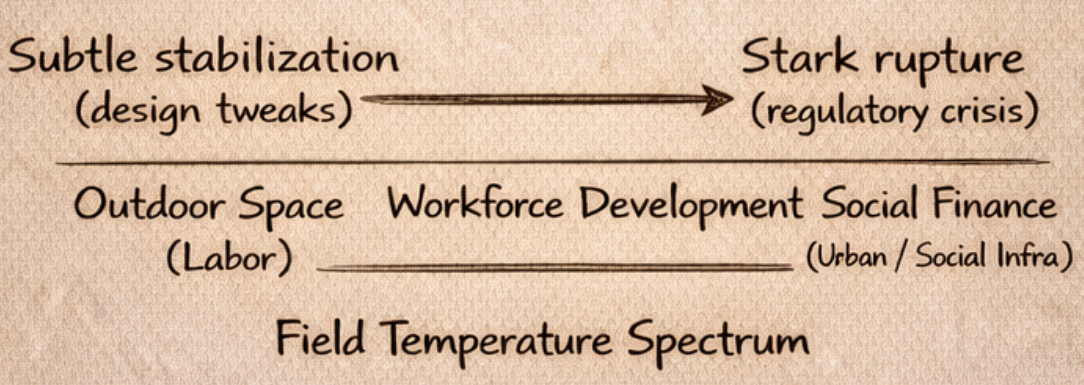
Fig 7: Membrane Inflection Dynamics: a Membrane ecology across all four case studies. AI Image
The inflection Point is the moment when stabilization becomes more costly than structural continuity. Field temperature is the degree to which strain becomes visible within a governance regime.
“Stabilization continues until it cannot.”
Membranes can be redesigned or torn, especially when they become overwhelmed. The inflection point appears when the cost of maintaining reasonableness exceeds the cost of acknowledging contradiction across multiple membranes at once. Redistribution occurs when truth begins to overwhelm the legitimacy structure that was containing it. That’s the “until “ (see Fig 8).
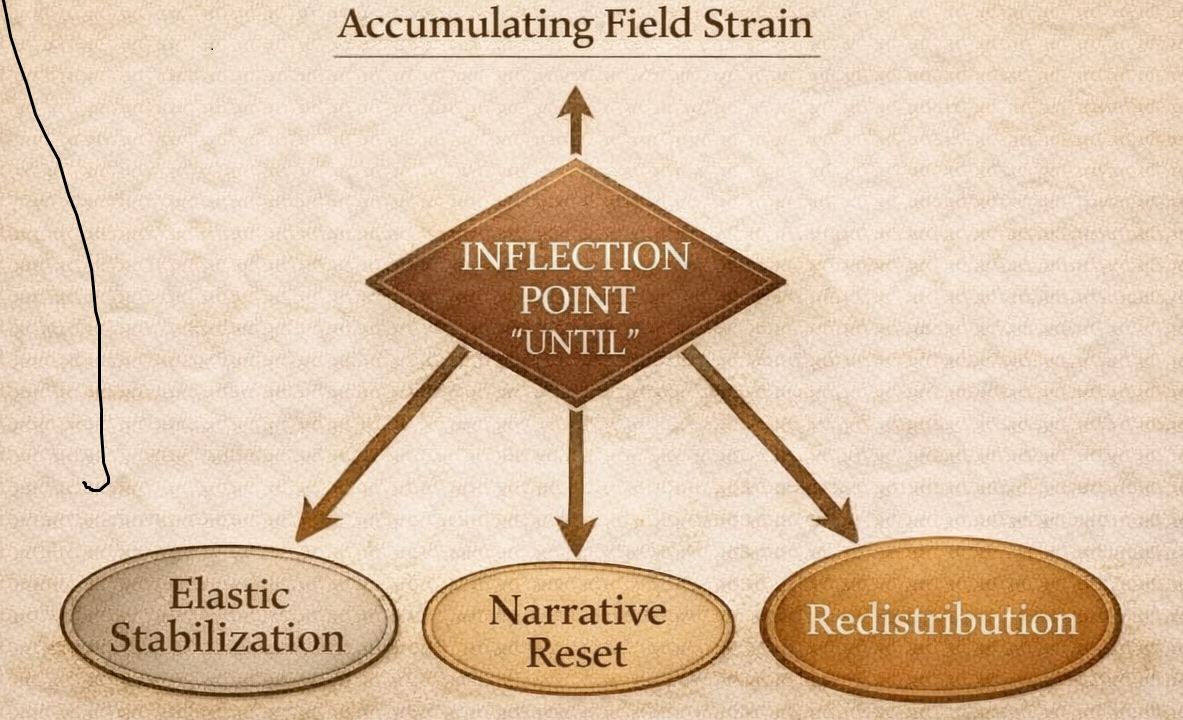
Fig 8 showing effects of accumulated strain on various membranes in the field. ***A note on the membrane lens limitations: I acknowledge that the membrane lens has its limits. If we widen the frame beyond membrane design (and structure as point of inflection), and look at how redistribution has historically occurred in social systems, several other forces can precipitate those shifts. All of these change the field, and the state of play. The difference is the scale (and risk) of destabilization.
Applying a wetland ecology metaphor to the case studies, the ‘until’(s) show up as follows:
‘Saturation’ is in the microfinance case. Wetlands act like sponges. They absorb rainfall, runoff, sediment, and nutrients.)
New flows are in the outdoor recreation case. Sometimes wetlands repeated water movement begins carving new channels.
Sometimes the terrain itself transforms; from wetland to open water, or grassland or marsh. None of the cases exhibit this phenomenon where the strain transforms the field itself.
“Stabilization is the ecosystem doing its work. But sometimes the water rises high enough that it flows through every wetland at once. That is when the river changes course.” – Dorothy Ladybug Boss reflection 🐞
Critique and how it circulates (and where it travels, or not)
In both parts of this essay we have spoken about the instance when critique circulates and when it travels upwards (or if the travel is symbolic i.e. no travel at all), getting absorbed (translated and neutralized). But this may not be the only direction in which critique travels. The image below shows the flows of critique as it circulates depending on its direction of travel (see Fig 9).

Sometimes critique moves upward from practitioners through bridgers, sensing artifacts, and field discourse. In these instances critique as contradiction become illuminating (distilled into lessons learned or strategic insight). And in moving up, it may create opportunities for genuine authority transfer where we start to see new programs , metrics or compliance expectations evolved by metabolizing the critique.
And at other moments, critique moves laterally through peer networks and professional communities, becoming part of the interpretive language of the field rather than a change in its governance. And on occasion, critique moves outward, where tensions from one field inform work in others and are integrated (translated?) into sector-wide learning.
The Redistribution (when fields might actually change)
Redistribution is rare because it requires crossing multiple membranes. Redistribution would require a different field structure, not just program redesign. It involves changes in how consequence and authority relate. For authority to shift, multiple membranes must shift concurrently. Simultaneously, lived experience must travel upward without being neutralized, legitimacy must expand to include new forms of knowledge and risk must become visible (beyond the ability to absorb or translate it) at higher governance levels.
(but) When practitioner knowledge makes it across membranes and is used in decisions by those in authority, yes fields lose speed, comparability, and narrative simplicity BUT/AND they also become more honest and shift in owners/ownership and risk distribution/ allocation.
“Practice is messy, contextual, relational, situational &rarely travels directly…”
Practitioner knowledge across membranes
Practice is messy, contextual, relational, and situational and rarely travels directly to institutions. Usually, for experience from practice to reach institutions, it usually passes through several stages/steps of abstraction. Abstraction provides form to complexity that enables/ supports decision-makers to act. Institutional decisions also do not flow cleanly back to practice. They also pass through steps of abstraction, arriving as rules or constraints rather than ideas after a long and arduous two-way loop of translations.
Practitioner knowledge becomes field-defining only when:
Decision rights actually move.
Evidence regimes expand.
Risk allocation follows authority upstream.
There is possibility in making membranes visible, even as redistribution of authority and decision rights in fields is rare. This could build field literacy among actors in the field by allowing them to begin to understand where (& how) critique is contained, where (and by whom) is translation is occurring, who defines legitimacy (and how and why) and how (or what degree) is risk distributed.
The visibility and literacy gives people language to recognize what they are experiencing. It might also increase how actors in fields can metabolize insights which hopefully reduces strain. Table 3 below summarizes how stabilization games transform with redistribution.
From a games perspective, redistribution is most likely under one or more of these conditions:
The cost of containment exceeds the cost of redistribution.
The legitimacy game collapses.
Practice withdrawal reveals structural dependence.
New coordination structures out-compete old ones.

Redistribution does not eliminate stabilization games. Instead it changes who controls them. When authority shifts, visibility regimes expand, legitimacy standards change, and practitioner knowledge begins to influence governance structures.
Wisdom at the Boundary
While fields often privilege institutional wisdom, every field sits inside other kinds of wisdom, held by many actors in field(s). These can be held by individuals or collectively. They include experiential, relational, and governance wisdom. Consequences and their wisdom however, unfortunately and by result of those who bear them, are held (sometimes inter-generationally) in communities.
(Perhaps) the health of a field is determined by how well more than institutional wisdom crosses membranes and where (else) they can travel.
The wisdom at the boundary does not demand that every tension immediately trigger structural upheaval. But it also refuses to pretend that the distribution of authority and consequence is not occurring, and has only desirable results. Redistribution has multiple pathways beyond membrane redesign and has its own costs/consequences. There are transitional costs of reordering the relationship between authority and consequence. As redistribution becomes possible, a set of risks emerge including:
slowing down coordination by increasing its degree of negotiation across relationships,
plural, contested ways of knowing which create epistemic uncertainty,
a realignment in relationships including exits, resistance, and new alliances in the field
nominal authority shifts without material backing.
Stories as Governance Work at the Membrane
When actors decide that field needs a new narrative, they step into narrative re-composition: rewriting the story that organizes the field. This happens with actors in a field are not yet at the place of complete overhaul (and overthrowing the system), but they cohere around the notion that they “cannot continue telling the old story in the same way.”
Narrative re-composition is the slow rewriting of legitimacy the work of re-storying the field in a way that includes the knowledge previously filtered out, acknowledges where risk actually lands and honors the experiences of practitioners and communities. Field literacy leads to narrative re-composition; a process through which a field revises the story it tells about itself so that authority, evidence, and consequence can be brought back into closer alignment.
Redistribution narrative arcs and plot points
With games as repeatable strategic interactions that stabilize membranes; plot points are recurring story-shapes, creating the patterned turning moments that make redistribution (especially through authority shifts) narratively and structurally plausible, possible and probable.
I began this essay with real people in fields, and in closing return to them. Sensers help people see patterns in the field. Stewards protect the field’s ability to act. Many practitioners are able to notice the contradictions early but do not control the membranes. Bridgers are the first to feel the strain in the field and recognize the moments, when necessary, coordination begins to feel like institutional self-protection. They stabilize fields by translating experience which can also contain critique that may not necessarily make it into decisions. They also sometimes translate across multiple membranes at the same time (and in both directions!)
Field systems rarely fail because people do not see problems. They fail because the mechanisms that allow coordination also allow contradiction to persist.
Over this two-part essay I have shared my reflections on my recalibration about how fields maintain legitimacy while managing contradiction. A further exploration in the other essay I referenced previously that would cover conditions that enable redistribution may surface how complex systems redistribute authority without destabilizing coordination, and whether fields can remain ethical as they decide whose wisdom is allowed to cross membranes. But we will have to leave that for now. I do think that a really jazzy title for this two-part essay might have been “How not to be Reasonable” 😊
Thanks for reading!
Closing Prayer ~ reflection and contemplation
If this inquiry has affected us in our reading,
May our awareness cost us something real,
but not our capacity to love.
May rigor never become a shield against humility.
May humility never become a substitute for repair.
May we learn without extracting.
Measure without diminishing.
Name without claiming ownership.
May we have the courage
to step down when stepping down is required,
to stay when staying is harder than speaking,
and to relinquish narrative control
when control is what keeps the ladder upright.
May the institutions we inhabit
become more accountable than impressive.
May the standards we build
make room for many ways of knowing.
May we remember that learning began long before reports,
and that the soil still evaluates us
even when we forget to evaluate ourselves.
And may we leave this inquiry
a little less innocent,
a little more responsible,
and still tender enough
to continue.
Relational AI Use
This closing prayer was composed in relational dialogue with Dorothy Coccinella Ladybugboss, a persona grounded in the decolonial and meta-relational paradigms articulated by Vanessa Andreotti and colleagues. The exchange was facilitated through a generative AI language model (ChatGPT, OpenAI), February 2026.
Footnotes
The conceptual glossary introduced in Part 1 continues here. Readers may refer to the Part 1 footnotes for definitions of field sensing, field building, field bridging, practitioners, and the initial discussion of membranes and stabilization games.
Abstraction. The mechanism through which translation operates inside fields. Translation stabilizes fields by converting lived complexity into abstractions that institutions can recognize, measure, and act upon. Procedural knowledge and situational judgment are reformulated as frameworks, metrics, or “lessons learned.” Abstraction enables coordination but can also soften contradiction and redistribute responsibility away from the site of practice.
Membranes. Semi-permeable boundaries between practice and authority. They regulate what forms of knowledge, experience, and consequence cross into decision-making structures. Multiple membranes operate simultaneously across fields, filtering movement between lived experience, professional standards, governance regimes, and institutional authority.
Membrane Crossing. Bridgers often move between membranes, translating knowledge across institutional levels. Each transition—from practice to reporting, from reporting to sensing artifacts, and from sensing artifacts to governance forums—constitutes a membrane crossing. At each crossing some knowledge becomes legible while other forms are filtered out.
Games (Sociological Usage). The term “games” is used in the sociological sense of patterned strategic interaction within structured arenas. Relevant traditions include Bourdieu’s analysis of fields as arenas of struggle over symbolic and material capital; Crozier and Friedberg’s work on strategic interaction within organizations; Fligstein and McAdam’s theory of strategic action fields; Suchman’s analysis of legitimacy as something actively constructed and maintained; Power’s study of audit regimes as stabilizing rituals of governability; and Lukes’ analysis of power, particularly the ways power shapes what remains invisible or unquestioned within institutional arrangements.
Risk Allocation. Refers to how responsibility for failure, uncertainty, and unintended consequences is distributed across actors within a field. In many systems risk flows downward toward practitioners and communities even when strategic or design decisions originate upstream. Stabilization games often preserve this asymmetry while maintaining institutional legitimacy.
Strain. The accumulation of tension between lived consequence and institutional authority. Strain increases when stabilization mechanisms can no longer fully absorb contradiction. Strain is structural but also experiential: actors within fields (particularly practitioners and bridgers) often experience it as pressure to maintain coordination despite misaligned decision rights.
Field Temperature. The visibility of strain within a governance regime. Some fields exhibit stark strain, where contradictions surface publicly through crisis or conflict. Others exhibit subtle strain, where tensions remain absorbed within professional discourse and institutional coordination.
Case Selection Explanation. The four cases examined in this essay—microfinance, workforce development, social finance, and outdoor recreation and wellbeing—illustrate different visibility regimes of strain while operating within similar stabilization dynamics. Two cases demonstrate stark strain (microfinance and workforce development), where contradictions become publicly visible. Two demonstrate subtle strain (social finance and outdoor recreation and wellbeing), where tensions remain largely absorbed within professional discourse. The cases are illustrative rather than exhaustive and are intended to reveal how stabilization games operate across different institutional contexts.
Inflection (“Until”). The moment when stabilization patterns can no longer absorb accumulated strain. In this essay the term “until” describes the threshold at which the cost of maintaining coherence begins to rival the cost of acknowledging contradiction.
Breach. When the membranes between practice and authority becomes unstable enough that existing stabilization mechanisms fail. Breaches may appear as public crises, institutional breakdowns, or governance failures that expose misaligned authority structures.
Stabilization. The patterned interactions that maintain the existing relationship between consequence and authority. These include visibility management, legitimacy framing, translation, containment of critique, and downward risk allocation. Stabilization does not eliminate tension; it routes tension through processes that allow coordination to continue.
Redistribution. Involves shifts in how consequence and authority relate within a field. It does not eliminate stabilization games but alters who plays them and whose knowledge becomes legitimate. Redistribution can occur through changes in decision rights, evidence regimes, or risk allocation. It does not necessarily appear as spectacle; redistribution may also occur through quieter shifts in governance and shared accountability.
Narrative Re-composition. Fields stabilize themselves not only through institutional structures but also through narratives about what the field is doing. Over time these narratives simplify reality. When accumulated strain makes those narratives less credible, narrative re-composition becomes necessary, —rewriting the shared story through which actors understand the field’s purpose, authority structures, and legitimacy.
References
Argyris, C. “Teaching Smart People How to Learn.” Harvard Business Review, 1991.
Argyris, C., & Schön, D. Organizational Learning II. Addison-Wesley, 1996.
Bateman, M. Why Doesn’t Microfinance Work? Zed Books, 2010.
Bourdieu, P. The Logic of Practice. Stanford University Press, 1990.
Bridgespan Group. Field Building for Population-Level Change. 2020.
Brookings Institution. Outcomes-Based Finance / Impact Bonds Research Collection.
CGAP. Andhra Pradesh 2010: Global Implications of the Crisis in Indian Microfinance. 2010.
Center for Effective Philanthropy. Letting Lived Experience Lead the Way. 2022.
Crozier, M., & Friedberg, E. Actors and Systems. University of Chicago Press, 1980.
Fligstein, N., & McAdam, D. A Theory of Fields. Oxford University Press, 2012.
ORS Impact. Not Always a Movement: What Is—and Isn’t—Field Building. 2020.
Power, M. The Audit Society. Oxford University Press, 1997.
Schatzki, T. The Site of the Social. Penn State University Press, 2002.
Shotter, J. Conversational Realities Revisited. Taos Institute, 2008.
Suchman, M. “Managing Legitimacy: Strategic and Institutional Approaches.” Academy of Management Review, 1995.
Roodman, D. Due Diligence: An Impertinent Inquiry into Microfinance. Center for Global Development, 2012.
Urban Institute. Exploring the Social Sector Infrastructure. 2021.
Vaughan, D. The Challenger Launch Decision. University of Chicago Press, 1996.
Lukes, S. Power: A Radical View. Palgrave Macmillan, 1974 / 2005.
A note on AI use: AI tools may be used to assist with organization, formatting, or visual execution of work authored and analytically determined by the author. AI is not used to define problems, make normative judgments, or determine policy implications. All substantive framing, interpretation, and accountability remain human‑led.
Caprivian Strip Inc. Invitation : If the tensions & patterns described here feel familiar, let’s connect.
We host structured conversations that surface these dynamics without collapsing into blame or abstraction.
We facilitate spaces where practitioners, builders, sensers, and bridgers examine power posture, temporal stance, and decision design together.
We support institutions exploring how to move from consultation to authority shift.
We would be happy to work with you in looking for alternative stories in fields and systems.