
Remarks and Resources from Halifax's Data Capacity Summit

Screenshot of the data summit promotion online
The Nonprofit Data Capacity Summit toured across Canada in Fall 2026. It comprised full day of sessions on data capacity for nonprofits, funders, and intermediaries in each city:
Toronto, ON — Oct 8, 2026 (cohosted with Purpose Analytics)
Calgary, AB — Oct 20, 2026 (cohosted with PolicyWise for Children & Families)
Winnipeg, MB — Oct 22, 2026 (cohosted with Canadian CED Network Manitoba)
Halifax, NS — Oct 27, 2026 (cohosted with Impact Organizations of Nova Scotia)
Diane Connors from Impact Organization of Nova Scotia (IONS) did a great job chatting with Tammy Mudge and I, as we worked our way through a more public version of our pre-summit conversation. It was great to see how it played out.
My remarks began with a more personal data story about needing to become responsible for medical records because my family doctor retired. shared this to contextualize the conversation that ‘data is not out there’ and for ‘the report’ or ‘the funder’. Data matters to us and its value, is much closer to home, and for more reasons than we think. It is important to learn about storage and use and updates — even in under-resourced low capacity organizations.
The arc I tried my best to follow for my responses to the conversation was:
My data story, everyone has a data story (or a few).
Practitioners role in bridging community realities and institutional
requirements. “More data beats clever algorithms, but better data beats more data.” — Brian Carriere, Ph.D.What if we already have enough data, and what we need is inspired action? People and communities are more than/not just data sources.
What data role do you hold? Owner, User, Steward, other? *(And)what about boards? Protect people and the data. Ask the difficult questions.
Remember when the data already exists.
To democratize the Q&A after our formal conversation, we used Slido* to capture questions and allow votes. We answered a few of them. But thankfully we also have the richness of all them to return to over and over again. *In modelling more participatory practices, I think we now can look at the outliers as well as those that got the most votes. And the questions were visible (and transparent) to everyone who used the Slido.
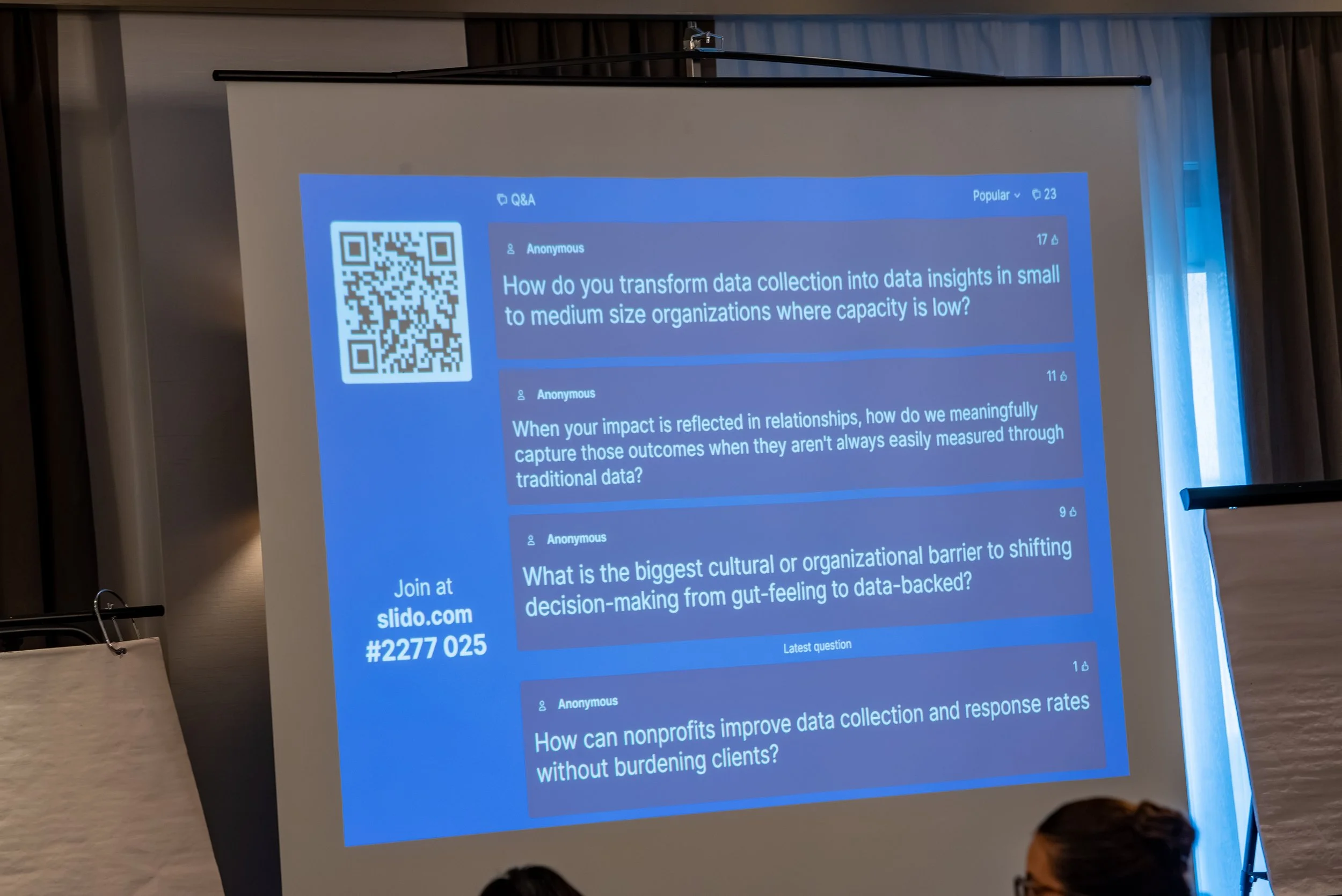
Photo of the Slido questions by @stoometzphoto
My answer was (mainly) don’t try to do this [ figure it out] on your own.
I hope we took that to heart and that we will consider how we might tap into existing resources (and networks and supports) and/or create a cohort of practitioners that want to connect to go further together (per the African proverb).
I look forward to further conversation, particularly in NS and Atlantic Canada about what’s next. I hope we maintain the momentum in the room.
‘Let’s Chat’ work with Me
Reach out to start a conversation and see how we might work together on this.